
Homeowners in the Dallas-Fort Worth area plan many kitchen renovations in 2026. Most projects cost between $25,000 and $85,000, depending on the specific city and material choices.
I remember my first major renovation in Plano. The homeowner felt overwhelmed by the options. We sat down and mapped out every penny. That project taught me that a clear plan saves thousands of dollars. Today, I share that experience with you. We will look at the current costs for Dallas, Fort Worth, and Frisco.
Texas Pro Remodeling serves the Dallas-Fort Worth Metroplex with expert design. And construction services to deliver high-quality, customized kitchen renovations for every homeowner.
Key Takeaways:
|
Kitchen Remodel Cost in Dallas Metroplex (2026 Overview)
A kitchen remodel in the Dallas Metroplex typically costs between $150 and $350 per square foot in 2026. Most homeowners spend an average of $45,000 for a full midrange update.
Costs vary across North Texas cities. Dallas and Southlake often see higher prices due to premium material demands. Smaller cities like McKinney or parts of Fort Worth might offer slightly lower labor rates. However, supply chain stabilization keeps material costs similar across the region.
| Location | Average Minor Remodel | Average Midrange Remodel | Average High-End Remodel |
| Dallas | $28,000 | $55,000 | $125,000+ |
| Fort Worth | $24,000 | $48,000 | $110,000+ |
| Plano/Frisco | $30,000 | $62,000 | $140,000+ |
| McKinney | $25,000 | $50,000 | $115,000+ |
Average Kitchen Remodel Cost Range in Dallas–Fort Worth
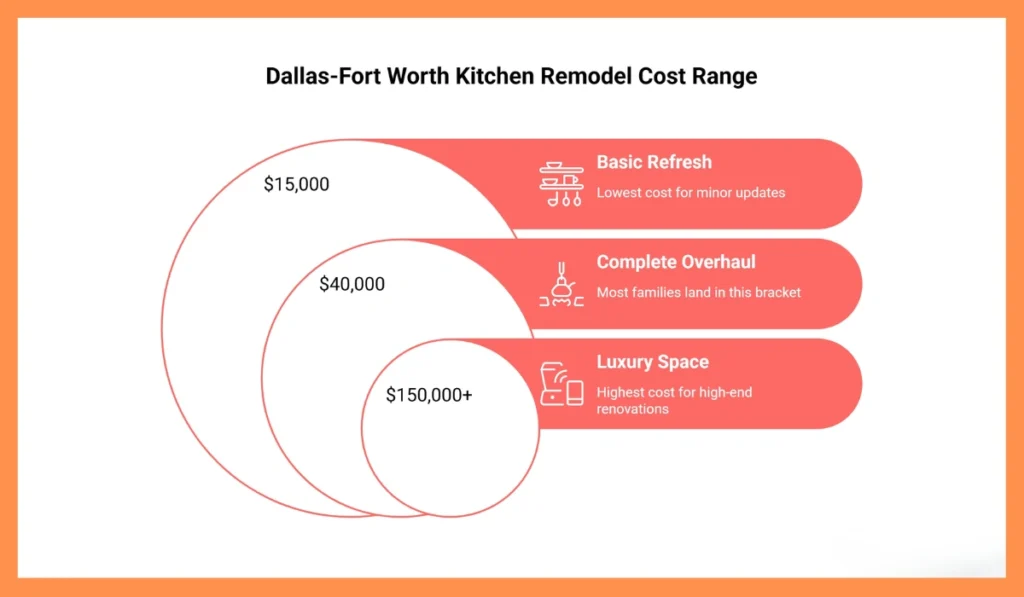
The average cost range for Dallas kitchen renovations starts at $15,000 for basic refreshes and reaches $150,000+ for luxury spaces. Most North Texas families land in the $40,000 to $70,000 bracket for a complete overhaul.
Economic shifts in 2026 influence these numbers. Labor remains the largest variable in the Dallas market. I see many people choosing mid-tier finishes to balance quality and price.
Minor vs Midrange vs High-End Kitchen Remodel Cost Dallas
A minor remodel costs $15,000 to $30,000, a midrange project costs $35,000 to $80,000, and high-end renovations exceed $100,000. These tiers define the level of structural change and material quality.
Minor updates focus on paint and hardware. Midrange projects replace cabinets and counters. High-end builds involve moving walls and installing professional-grade appliances like Sub-Zero or Wolf. This is a bit costly, but it can transform your Dallas home into a whole new level.
Kitchen Remodel Cost per Square Foot Dallas
The cost per square foot for a Dallas kitchen remodel ranges from $150 to $250 for standard updates. Professional gut renovations often start at $300 per square foot when you include structural changes.
You can calculate your estimated base cost with a simple formula. Multiply your kitchen’s total square footage by the local average rate. This gives you a starting point for your discussions with contractors.
The Square Foot Formula:
Total Cost=Square FootageQuality Rate per SF
Where:
- Square Footage (SF) → The total area of the space you are measuring.
- Quality Rate per SF → The cost per square foot depends on the quality or grade of the materials/work.
For example:
If you have 1,500 SF and the quality rate is $120 per SF, then:
Total Cost=1500120=180,000
So the total cost would be $180,000.
What Impacts Kitchen Remodeling Costs in Dallas-Fort Worth
Material selections, labor availability, and the scope of work serve as the primary cost drivers. Structural changes like moving gas lines or walls increase the total investment by 30% to 50%.
I often find that hidden issues behind walls drive up costs. Old wiring or plumbing leaks require immediate fixes during the demo. We always advise clients to look at the hidden costs of kitchen remodeling before they begin the demolition phase.
Kitchen Size and Layout Complexity
Larger kitchens require more materials and longer labor hours. A complex layout with an island or custom angles adds 15% to 20% to the total labor bill.
Standard 10×10 kitchens remain the benchmark for pricing. If you expand your footprint into a dining room, your costs will rise. We see many Dallas homeowners removing walls to create open-concept living areas this year.
Scope of Work (Rip-and-Replace vs Full Gut Renovation)
A “rip-and-replace” project costs significantly less than a full gut renovation. Keeping your plumbing and electrical in the same spots saves approximately $5,000 to $10,000.
Gut renovations involve removing all drywall and starting from the studs. This path allows for better insulation and updated wiring. Most 2026 projects in older Dallas neighborhoods require this level of work for safety.
Finish Levels and Design Complexity
Your choice of finishes determines roughly 40% of your total budget. Custom cabinetry and exotic stone slabs carry much higher price tags than stock options.
I suggest picking one “hero” element for your kitchen. Perhaps you choose a high-end quartz island. You can then save money on a simpler backsplash. This strategy keeps the design beautiful while protecting your wallet.
Labor Costs and Subcontractor Scheduling
Labor rates in Dallas currently range from $50 to $150 per hour for skilled trades. High demand for contractors in Frisco and North Dallas keeps these prices firm.
Master plumbers and electricians charge premium rates. We recommend booking these pros at least two months in advance. Busy schedules can cause delays if you do not plan ahead.
Permit and Inspection Requirements in Plano and Dallas
Permit fees in Dallas cities usually range from $500 to $1,500. Dallas and Plano have strict codes for electrical and plumbing updates to ensure home safety.
The city must inspect your “rough-in” work before you close the walls. I always include permit management in my project plans. This prevents legal issues when you try to sell your home later.
Kitchen Remodel Cost Breakdown Dallas (Line-Item Estimate)
Cabinetry usually consumes 30% of the budget, while labor takes 25%, and appliances take 15%. The remaining funds cover countertops, flooring, and lighting.
Detailed line-item estimates prevent surprise expenses. I tell my clients to review every category carefully. This clarity helps you decide where to splurge and where to save.
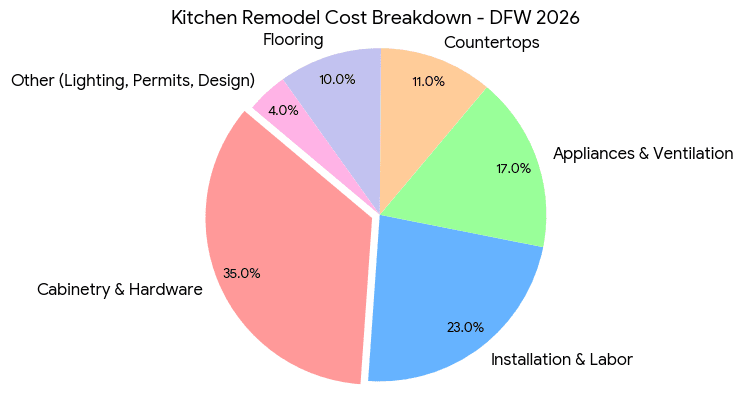
Here is the pie chart showing the kitchen remodel cost breakdown for the Dallas Metroplex in 2026.
Kitchen Cabinet Replacement and Refacing Costs
New custom cabinets in Dallas cost $15,000 to $30,000, while refacing costs $7,000 to $12,000. Cabinetry remains the most expensive physical component of your kitchen.
Semi-custom cabinets offer a great middle ground. They provide quality construction with many style options. We see many homeowners in McKinney choosing navy or forest green finishes this year.
Countertops (Quartz vs Granite Cost Dallas)
Quartz countertops currently cost $65 to $150 per square foot installed. Granite remains a popular, slightly more affordable choice at $50 to $100 per square foot.
Brands like Cambria and Caesarstone lead the market in Dallas. I prefer quartz for its low maintenance. You never need to seal it, which saves you effort over the years.
Flooring, Backsplash, and Lighting Upgrade Costs
Luxury vinyl plank (LVP) and large-format tile are the top flooring choices for 2026. Most flooring installs cost $8 to $15 per square foot, including materials.
A new backsplash adds a vital design punch for $1,000 to $3,000. We also suggest adding under-cabinet LED lighting. This small upgrade significantly improves the functionality of your prep space.
Appliance Install and Range Hood Ventilation
A full appliance suite from brands like KitchenAid or Bosch costs $6,000 to $15,000. Installation fees usually add $500 to $1,500 to the total.
Proper ventilation is essential for Texas kitchens. A high-quality range hood keeps your air clean. We recommend venting the hood to the exterior of the house for the best results.
Plumbing and Electrical Rewiring Costs
Updating your plumbing and electrical systems costs between $3,000 and $7,000. This work ensures your new kitchen meets the 2026 building codes.
Modern kitchens require more circuits for heavy-duty appliances. I always check the main electrical panel during the first visit. Sometimes an upgrade to the panel is necessary for your new ovens.
Labor Cost, General Contractor Markup, Overhead and Profit
General contractors typically charge a 10% to 20% markup on the total project cost. This fee covers their management, insurance, and project coordination.
The markup ensures your project stays on track. I handle the scheduling of all subs so you do not have to. This peace of mind is worth the investment for most busy families.
Budget Allocation Table
To ensure your project stays on track, you can use these figures as a baseline for your estimates:
| Cost Category | Percentage of Total Budget | Estimated Spend (on $50k Budget) |
| Cabinetry & Hardware | 35% | $17,500 |
| Installation & Labor | 23% | $11,500 |
| Appliances & Ventilation | 17% | $8,500 |
| Countertops | 11% | $5,500 |
| Flooring | 10% | $5,000 |
| Other (Lighting, Permits, Design) | 4% | $2,000 |
Kitchen Remodel Budget Guide for Dallas Homeowners
A realistic kitchen budget should stay within 10% to 15% of your home’s total value. For a $500,000 home in Frisco, a $50,000 to $75,000 budget is appropriate.
We use this rule to protect your return on investment (ROI). Spending too much can make it hard to recoup costs during a sale. Spending too little might result in a kitchen that feels cheaper than the rest of the house.
Realistic Budget by Home Value & ROI Considerations
Kitchen remodels in Dallas offer a high ROI, often returning 60% to 80% of the cost. Homes with updated kitchens sell faster in the competitive North Texas market.
I look at recent sales in your neighborhood to guide the budget. If every neighbor has granite, you should probably choose quartz or granite. Matching the neighborhood standard is a smart financial move.
Contingency Budget & Change Order Process
Every project needs a 10% to 15% contingency fund for unexpected repairs. Change orders occur when you decide to modify the design after construction begins.
I always explain the change order process before we start. This document tracks the cost of any new requests. It keeps the budget transparent and prevents arguments at the end of the job.
Value Engineering Tips to Reduce Costs Without Cutting Quality
Value engineering means finding smarter ways to achieve the same look. You can use open shelving instead of upper cabinets to save thousands.
I also suggest keeping the existing sink location. Moving a sink requires digging into the slab or moving joists. These savings allow you to buy the high-end stove you really want.
Financing and Payment Schedules for Kitchen Remodels
Most Dallas contractors use a draw schedule tied to project milestones. Homeowners often use HELOCs or personal home improvement loans to fund the work.
We never recommend paying 100% upfront. A fair schedule protects both the homeowner and the builder. It ensures work happens before the next payment is released.
Contractor Payment Schedule and Draw Milestones
A typical schedule involves 25% at signing, 25% at start, 25% at countertop install, and 25% at completion. This keeps the cash flow steady for materials and labor.
I provide a clear calendar with these dates. You will know exactly when each check is due. This clarity helps you manage your bank transfers without stress.
Loans, HELOCs, and Financing Options in Texas
Texas homeowners have great access to Home Equity Lines of Credit (HELOCs). These loans often have lower interest rates than personal credit cards.
I see many people choosing 10-year or 15-year financing terms. We suggest talking to a local Texas lender early. Getting a pre-approval letter makes the contracting process much smoother.
How Long Does a Kitchen Remodel Take in Dallas?
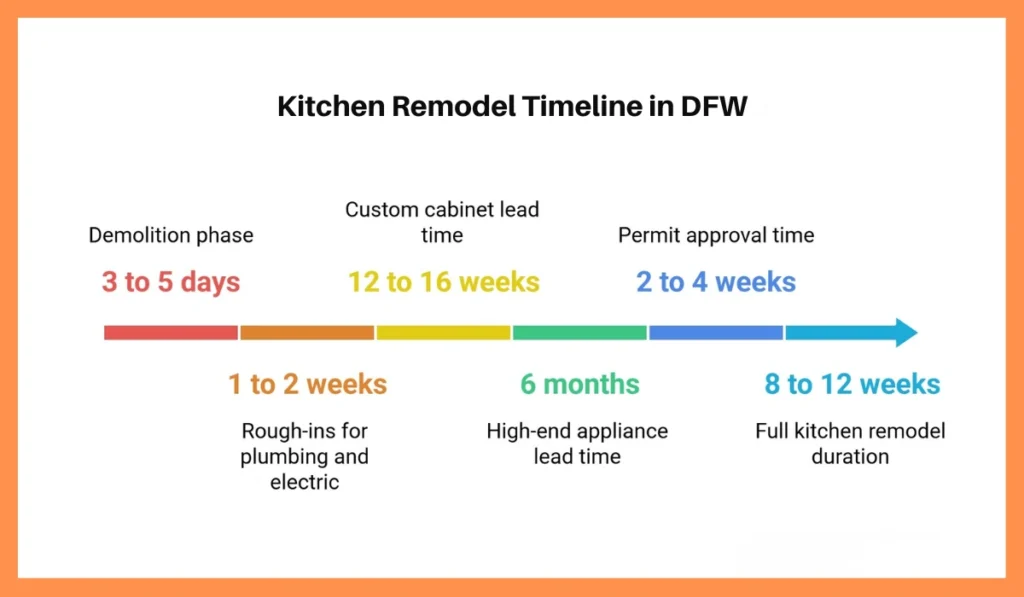
A full kitchen remodel takes 8 to 12 weeks on average in Dallas-Fort Worth. Selecting the best remodeling timing along with planning and material ordering add another 4 to 8 weeks before the demo starts.
Timeline management is our biggest priority. At Texas Pro Remodeling, we aim to minimize the time you spend without a working kitchen. I always create a detailed Gantt chart to track every phase.
Typical Timeline from Demo to Final Walkthrough
Demolition takes 3 to 5 days. Rough-ins for plumbing and electric take 1 to 2 weeks. Cabinet installation and countertop fabrication usually take the longest.
You should plan for a dusty phase during the first three weeks. I suggest setting up a temporary kitchen in the dining room. A microwave and a hot plate will be your best friends during this time.
Cabinet and Appliance Lead Times in 2026
Custom cabinets currently have a lead time of 12 to 16 weeks. High-end appliances can take 6 months if they are backordered.
We order these items the moment the design is signed. I wait to start the demolition until the cabinets arrive in the warehouse. This strategy prevents your kitchen from sitting empty for months.
Permit Turnaround Time and Inspection Scheduling
Permit approval in cities like Dallas can take 2 to 4 weeks. We submit plans early to avoid delays in the construction schedule.
Inspections happen at specific points. We cannot move to the next step until the city inspector signs off. I maintain good relationships with local inspectors to keep things moving.
Timeline Buffer and Order of Operations
We add a one-week buffer to every project schedule. This accounts for minor shipping delays or illness among the crew.
The order of operations is vital for quality. We install flooring before the cabinets in most cases. This ensures a level surface and a professional finish throughout the room.
Step-by-Step Kitchen Remodel Project Phases
A successful renovation relies on a structured sequence of phases to maintain clarity and control. The process moves from Design to Procurement, then Construction, and finally Punch List. Each phase requires specific approvals from the homeowner. So, you can plan your summer remodel to ensure the timing and budget align with your vision.
Moving methodically through design, procurement, and construction ensures that every detail aligns with your budget and vision. This organized approach is the most effective way to manage kitchen remodeling while delivering high-quality, long-lasting results within your home.
Planning and Design Phase (Design Fee & Cabinet Layout Plan)
The design phase takes 2 to 4 weeks. We create 3D renderings so you can see your new kitchen before we swing a hammer.
Design fees in Dallas range from $2,500 to $7,000. I believe this is a vital investment. A good plan prevents expensive mistakes during the actual construction.
Pre-Construction and Material Procurement
During this phase, we collect all the materials. We check every box for damage as it arrives. This ensures we have everything we need to work continuously.
I recommend picking your hardware and faucets during this time. These small details can take time to ship. Having them ready on day one keeps the momentum high.
Construction Phase (Drywall, Paint, Cabinet Installation, Countertops)
This is the most active part of the project. You will see different crews in your home every day. We manage the mess with plastic barriers and air scrubbers.
The kitchen starts to look real once the cabinets go up. After the cabinets are set, the countertop team comes to “template.” Fabrication usually takes 7 to 10 days after templating.
Punch List, Final Walkthrough, Warranty and Service
The punch list is a list of small touch-ups at the very end. We might need to adjust a drawer or paint a tiny scuff.
I do a final walkthrough with you to ensure you love every inch. We provide a written warranty for our labor. This gives you confidence that your investment is protected for years.
Demo to completion takes 4 to 12 weeks for construction.
| Phase | Typical Duration |
| Design & Planning | 2–4 weeks |
| Permits | 1–4 weeks |
| Construction | 4–12 weeks |
| Final Walkthrough | 1 week |
Kitchen Remodel Permits and Legal Requirements in Dallas
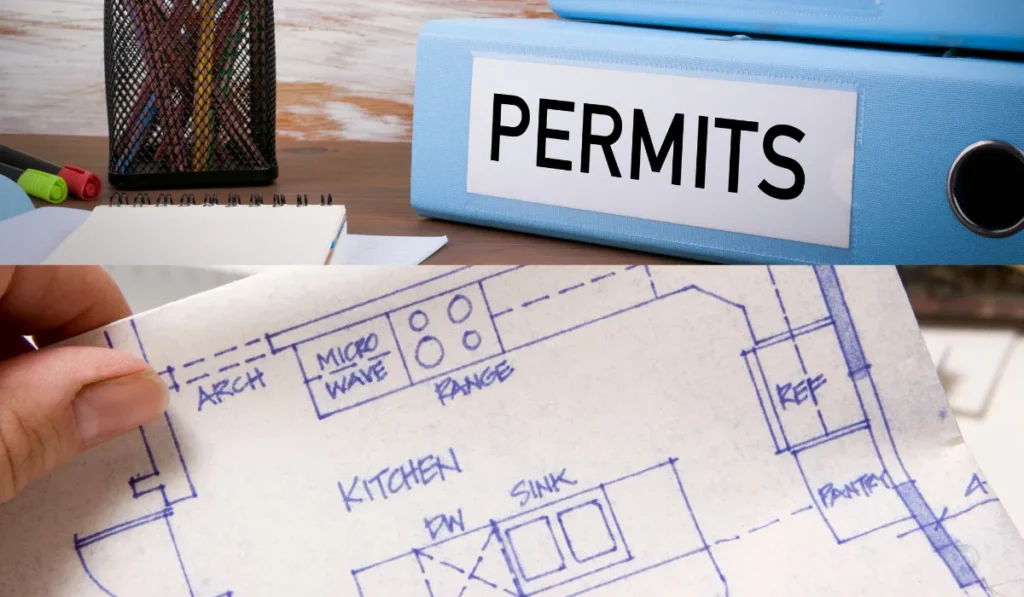
Most North Texas cities require a Residential Combination Permit. This covers building, electrical, plumbing, and mechanical work in one document.
Each city has its own portal for applications. I handle the paperwork for my clients in Dallas and Plano. We make sure every update follows the latest safety standards.
Plumbing, Electrical, and Structural Permit Requirements
You must have a permit if you move a sink or add a new gas line. Electrical permits are required for adding any new outlets or lights.
Structural permits are necessary if we remove a load-bearing wall. We often hire a structural engineer to provide stamped drawings. This ensures your house remains stable and safe.
Inspection Scheduling and Compliance Tips
We schedule inspections at least 48 hours in advance. The job site must be clean and ready for the inspector to see the work.
I stay on-site during the inspections to answer questions. This proactive approach helps us pass the first time. It keeps the project moving toward the finish line without pauses.
Choosing the Right Kitchen Remodeling Contractor in Dallas
Choose a contractor with local experience, clear pricing, and strong project control. A good contractor protects your budget and timeline. A poor contractor creates delays and extra costs.
Texas Pro Remodeling works with homeowners in Dallas, Fort Worth, Plano, and Frisco. The team builds kitchens that match lifestyle needs and budget goals. They help you determine the ideal remodeling time while using local permit knowledge. The company uses local permit knowledge and skilled trades to keep projects on schedule. Homeowners trust Texas Pro Remodeling for clear pricing, simple communication, and strong warranty support.
Design-Build Firm vs General Contractor
A design-build firm manages design and construction under one contract. A general contractor manages construction only. Design-build reduces delays and confusion. General contractors work with separate designers and architects.
Many Dallas homeowners prefer design-build services. NAHB reports integrated teams can reduce project timelines by up to 15 percent.
What to Ask During a Kitchen Remodel Consultation?
Ask about timeline, budget control, permits, and warranty terms. These questions show how the contractor manages risk and quality. Ask how they schedule inspections in Dallas and Plano. Ask how they manage cabinet and appliance lead times. Ask how they approve cost changes with clients.
How to Compare Kitchen Remodel Quotes Dallas?
Compare quotes by scope, materials, labor, and contingency budget. The lowest price often misses key line items. A detailed quote shows cabinet costs, countertop allowances, labor hours, and permit fees. Remodeling Magazine states transparent estimates improve homeowner satisfaction and ROI.
Conclusion
A kitchen remodel in the Dallas Metroplex is a significant but rewarding investment in 2026. Costs generally range from $45,000 to $85,000 for a full midrange project. The process takes about 3 months from start to finish. You must plan for material lead times and city permits early in the year. By choosing quality materials and the right local contractor, you can increase your home’s value.
Homeowners choose Texas Pro Remodeling. Because they value transparent pricing, clear communication, and long-term warranty support.
Frequently Asked Questions (FAQs)
How far in advance should I order cabinets and appliances?
Order these items 4 to 6 months before you want to start construction. Cabinet lead times remain long in 2026. Having them in the warehouse prevents delays during your project.
Is it cheaper to keep the same kitchen layout?
Yes, keeping the layout saves $5,000 to $15,000. You avoid the costs of moving gas lines, drains, and electrical wiring. This is the best way to save money on a renovation.
How much should I set aside for unexpected expenses?
Set aside 15% of your total budget for surprises. Old homes often have hidden rot or outdated wiring. This fund ensures you can finish the project without financial stress.
How do I avoid delays during a kitchen renovation?
Select all your materials before the project starts. Ensure your contractor has a firm schedule for every subcontractor. Clear communication and early ordering prevent most common delays.
Does moving plumbing or gas lines increase the timeline?
Yes, moving lines adds 1 to 2 weeks to the project. We must cut into the foundation or floor to relocate pipes. This work also requires extra inspections from the city.