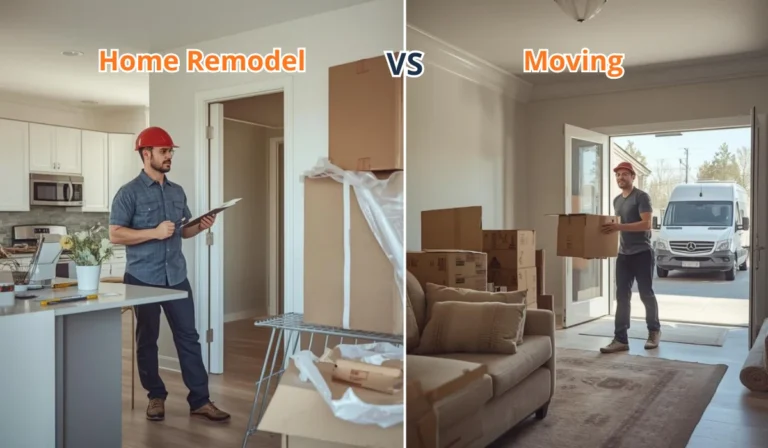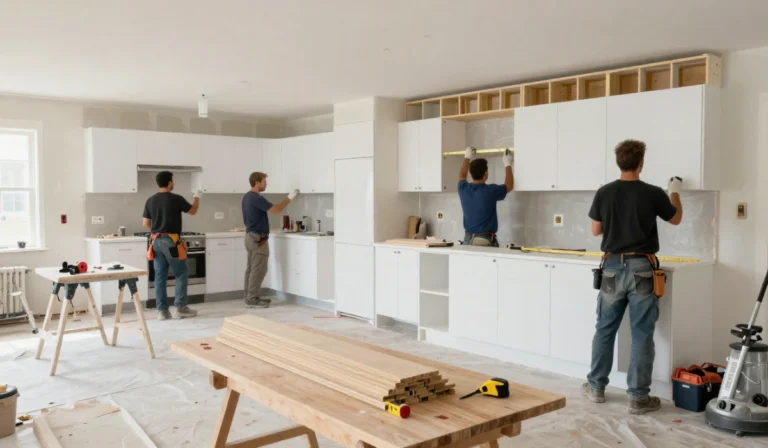



Deciding whether to remodel or move comes down to a simple reality: in today’s market, staying put and renovating is almost always the smarter financial move than moving. It allows you to transform your house into the home you actually want while protecting your current interest rate and avoiding the massive costs of selling.
Many homeowners are struggling to decide between remodeling and moving. It’s quite challenging to make the final decision. That’s why I have noted down the key points you should understand before taking the first step towards your plan.
Key Takeaways
|
Key Factors to Consider Before Deciding: Stay or Move?
Renovating is smarter if your location and lot meet your long-term needs; moving is necessary only if the property cannot adapt to your space requirements. A professional house painting update can often revitalize a space enough to help you see its long-term potential before committing to a larger move.
I recently saved a Plano neighbor from a $500,000 relocation just by removing one wall to fix their functional layout. Before you pack, compare local listings against a renovation budget. If the bones are good, staying wins.
Identify Fixable Home Issues vs. Permanent Limitations
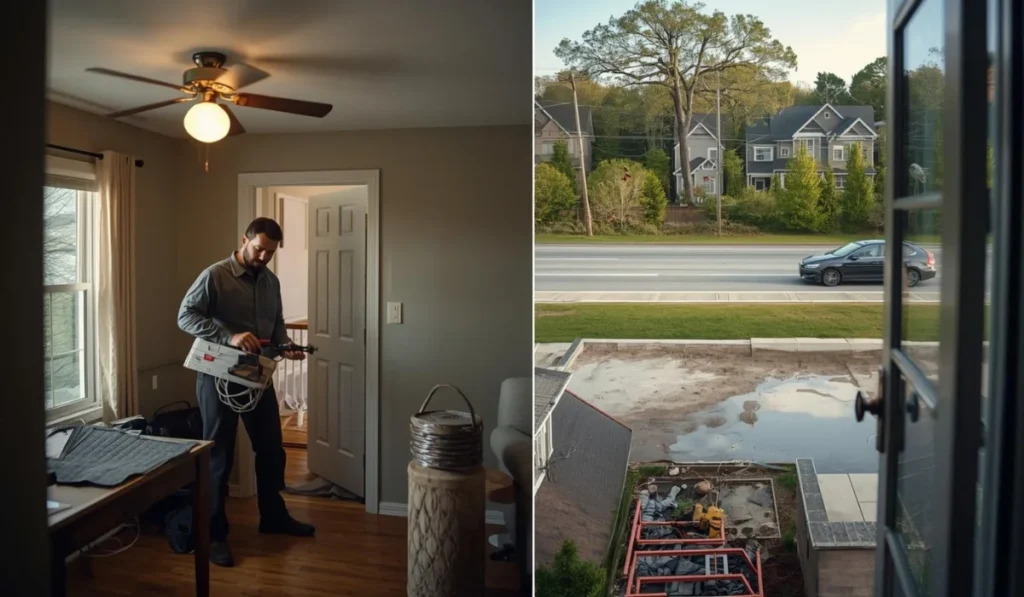
Fixable issues are structural changes within your property lines. Permanent flaws are tied to the land. Homeowners can knock down walls to improve a functional layout, but they cannot fix a noisy highway or a mismatched school district.
A dated HVAC or cramped kitchen is a standard fix. However, location stability is permanent. I once worked with a client near a DFW tollway expansion; we realized no amount of soundproofing could fix the location.
- Fixable: Old roofing, poor lighting, or dated interiors.
- Permanent: Traffic noise, poor lot drainage, or small lot size.
Evaluate the Long-Term Value of Your Home’s Location and Neighborhood
Renovations solve interior layout and cosmetic issues, but they cannot fix land-level flaws or neighborhood instability.
I advise homeowners to look past the dated finishes. You can knock down walls to improve a cramped functional layout, but you cannot renovate a small lot, high-traffic noise, or a school district that no longer fits your family. These are permanent factors that determine your long-term location stability.
I recently helped a Frisco family gain two rooms through an attic conversion, keeping them in a neighborhood they loved.
Understanding the benefits of home renovation firsthand, they were able to stay near their friends and schools while enjoying a much larger living space. On the other hand, a client near a DFW airport expansion had to move; no amount of soundproofing could fix the flight path noise.
Remodeling vs. Moving: Breaking Down the True Costs
Renovating is the most cost-effective way to upgrade. While moving forces you to pay transactional taxes of 8% to 10% in sunk costs, a full home remodeling project lets you reinvest that capital directly into your home’s equity.
Cost of Selling Your Home and Moving
When you sell your home in Dallas-Fort Worth, you are not just trading one asset for another; you are paying what I call a transactional tax. This is the combined total of realtor fees and closing costs required to finalize a sale.
In the current 2026 market, the NAR average for total commissions in Dallas sits at 5.88%. However, your closing costs, which include title insurance, escrow fees, and prorated property taxes, typically add another 3% to 4% to that bill.
You must expect to lose 8% to 10% of your home’s value just to complete the transaction. On a $500,000 DFW home, you are looking at roughly $45,000 to $50,000 in sunk costs.
While staging is a relatively low expense (averaging around $1,800 to $2,500), it is another out-of-pocket cost that does not follow you to your next home.
I tell my clients that if their current home just needs a $50,000 face-lift, they are better off investing that money into their own equity rather than handing it over in closing costs to move into a house that might still need work.
Remodeling Costs
In 2026, the average cost for a whole-home renovation in the Dallas-Fort Worth area typically falls between $20,000 and $100,000, though high-end gut renovations for larger homes often exceed $200,000.
On a square-footage basis, you should budget $15 to $60 per square foot for cosmetic updates (paint, flooring, and fixtures) and $82 to $107+ per square foot for structural “gut” remodels that involve moving walls or updating major systems.
Here are the current remodeling costs based on different projects:
| Project Type | 2026 Estimated Cost (DFW) | Key Drivers |
| Mid-Grade Kitchen | $25,500 – $32,100 | Cabinetry, Quartz Countertops |
| High-End Kitchen | $50,000+ | Custom Millwork, Premium Fixtures |
| Master Bath Remodel | $15,300 – $26,750 | Tile Work, Plumbing Rerouting |
| Whole House (Gut) | $82 – $107 per sq. ft. | Structural Work, Full MEP Updates |
Labor accounts for 50%–60% of the budget. Home improvement costs climbed nearly 4% in the first quarter of 2025 year-over-year, largely due to labor costs, making it even more important to vet contractors carefully. Strategic DFW remodels currently maintain a strong 60%–70% ROI.
How Mortgage Rates Affect the Renovate-or-Move Decision?
Mortgage rates and inventory now dictate the choice. For many, a low-rate mortgage is a financial asset that is nearly impossible to replace.
Remodeling spending in the U.S. is expected to grow by about 1.2% in 2025, indicating modest recovery after recent declines, which suggests more people are choosing to update their existing high-value assets rather than re-enter a high-interest market.
Comparing Mortgage Rates to Market Rates
If your current rate is below 4%, moving at today’s 6.3% market rate creates golden handcuffs. One of the primary reasons people renovate now is to keep their low monthly payments while getting the upgrades they need.
- The Payment Gap: Swapping a 3% rate for 6.3% on a $400,000 loan adds nearly $800 in monthly interest.
- Preserving the Asset: Renovating keeps your low-interest base mortgage intact, applying current rates only to a smaller equity loan.
Impacts of Limited Inventory on Move-In Ready Prices
Low inventory has turned move-in-ready homes into a high-priced luxury, as owners stay put to protect their rates.
- Convenience Premium: Buyers pay roughly 3.7% more for “cost certainty” in finished homes.
- Fixer-Upper Opportunity: Homes needing work sell for about 7.3% less, favoring those willing to manage a project.
- Building vs. Bidding: Renovating lets you bypass bidding wars and invest that “market premium” directly into your own home.
How to Use Home Equity to Finance a Remodel?

Homeowners can leverage their property’s value to fund upgrades through three main methods:
- HELOC: A revolving line of credit that works like a credit card. You only pay interest on what you use, making it ideal for phased projects. When you decide to invest in your home remodel, this flexibility helps manage cash flow during fluctuating rates.
- Home Equity Loan: A lump-sum loan with a fixed interest rate. It offers predictable monthly payments, which is best for projects with a set, upfront cost.
- Cash-Out Refinance: Replaces your current mortgage with a new, larger one, giving you the difference in cash. Note: This may not be ideal if your current rate is significantly lower than market rates.
Interest on home equity debt may be tax-deductible if the funds are used to substantially improve the home. Additionally, strategic DFW renovations currently see a 60%–70% ROI, essentially using your home’s worth to increase its future value.
Lenders generally require a 20% safety barrier. Your tappable equity is 80% of the home’s appraised value minus your mortgage balance. This cushion protects you from market dips and ensures you qualify for competitive rates.
| Warning: Interest is only deductible if used for substantial improvements. Repairs (like fixing a leak) do not count. Keep all receipts to prove you added permanent value. |
Does Remodeling Increase Your Home’s Value?
Remodeling increases home value only when the project aligns with your local neighborhood resale ceiling. While certain upgrades like garage door replacements can yield an ROI of over 200%, major luxury overhauls often struggle to recoup their full cost. Here is how remodelling increases the home value:
Remodeling Projects With the Highest Return on Investment
The remodeling projects with the highest return on investment are those that enhance a home’s first impression and fundamental efficiency. Beyond the numbers, these projects offer the real-life benefits of remodeling your home by improving your daily comfort and how you interact with your space.
| Renovation Project | Estimated ROI | Key Takeaways |
| Curb Appeal (Garage or Steel Entry Door) | 194%–268% | Boosts first impressions and appraised value. |
| Minor Kitchen Refresh | 96%–113% | Modern looks at a fraction of the full remodel cost. |
| Siding & Stone Veneer | 114%–208% | Durable, low-maintenance exterior upgrade. |
| Primary Suite Remodel (Joy Factor) | 54%–60% | Adds lifestyle satisfaction if staying put. |
Avoiding Over-Improving Beyond Your Neighborhood’s Value
To avoid over-improving, stay within your neighborhood resale ceiling. Homes rarely sell for more than 10% to 15% above the highest local comp.
- Appraisers cap your value based on nearby sales, often devaluing high-end finishes in modest areas.
- When selecting specific remodeling projects to add value to home properties, it is essential to research sales within a half-mile to find your price ceiling; spending beyond it yields no return.
- Avoid hyper-personalization and themed rooms, as they lower your ARV by shrinking the buyer pool.
- Stick to your neighborhood’s gold standard materials to ensure you do not overspend on unrecoverable luxury.
Lifestyle Considerations: Living Through a Remodel vs. Moving
Choosing between a remodel and a move involves balancing temporary stress against long-term stability. Staying put means navigating a construction zone for 3 to 6 months. Moving offers an immediate “fresh start” but carries high financial and emotional costs.
Managing Disruption and Timeline Risks
Renovating typically takes 3–6 months. To manage risk, budget a 20% time buffer and 15% contingency. Moving is faster, but the temporary chaos of a remodel is a small price to keep a great school district or community.
HOA and Zoning Restrictions
Clear these legal challenges before starting:
- HOA: Exterior reviews can delay projects by 2 months.
- Zoning & Permits: Setbacks limit footprints; permits take 4–6 weeks.
- Deed Restrictions: Local rules may ban specific materials or additions.
Final Thoughts
Choosing between remodeling or moving depends on your mortgage rate and lifestyle goals. If you have a low interest rate and love your neighborhood, remodeling is the smartest way to build wealth.
However, if your current house simply can’t fit your needs or neighborhood rules block your plans, moving is the better choice. Weigh the costs, trust your gut, and choose the path that fits your future.
If are choosing to stay instead of moving, let’s make it your dream home. Contact Texas Pro Remodeling today to start your renovation journey.
Frequently Asked Questions
Is it possible to live in my house during a major remodel with kids?
Yes, but you must establish clean zones and follow a phased schedule to keep functional areas like a temporary kitchen or safe play space accessible for your family.
What is the Mortgage Swap Penalty?
It is the sharp increase in your monthly payment (often $800–$1,000+) caused by trading a low legacy interest rate for a much higher current market rate.
Does a home addition always increase property value?
Not necessarily; an addition only adds value if the total cost stays below your neighborhood’s price ceiling and aligns with local buyer expectations.
Can I use a HELOC to pay for moving expenses if I decide to sell later?
Yes, you can draw from a HELOC for transitional costs, but the full balance must be settled from your home’s sale proceeds at closing.
How do HOA regulations affect the remodel vs. move choice?
If strict HOA rules or deed restrictions legally block the square footage expansion you need, moving becomes the only way to gain the space you require.